
The craft
Every bead is
a decision.
People use words like handwork and embroidery as though they mean one thing. They don't. Here is what actually happens to a piece before it reaches you, and why each part of it is slow.
Zari border, pearl latkan and a beaded back panel on one piece.
Maggam work
also called aari
The fabric is stretched drum-tight on a wooden frame, the maggam, and the karigar works it from underneath with a fine hooked needle, the aari. Each pull brings the thread up through the cloth in a chain stitch, and a bead or a stone can be caught on every single one of them.
The hook is quicker than a sewing needle in trained hands, which is the only reason dense work like this is possible at all. It is still counted in days, not hours. A heavily worked blouse back can carry two thousand beads, every one set individually, and a hand that hurries leaves an uneven line you can see from across a room.
Zari
the metal thread
Zari is metallic thread, traditionally real silver wire, gilded and wound around a silk core. It is either woven straight into the border and the pallu on the loom, or couched onto the surface afterwards in raised motifs.
Metal does not behave like cotton. It kinks, it resists the needle, and it has to be laid flat and caught down rather than simply stitched through. That is why a real zari border catches light in a line instead of glinting at random. It is lying exactly where somebody put it.
Stone work
kundan and cut glass
Stones are placed one at a time. Some are sewn through holes drilled in the stone itself, others are held by a tiny metal claw setting that is stitched down around them. Nothing is glued on anything we sell. Glue yellows, and it lets go in the first monsoon.
Every stone is an individual decision: which one, which angle, how far from its neighbour. A motif of forty stones is forty small acts of judgement, and it takes as long as it takes.
Pearl work
and the latkan
Pearls and drop beads are threaded and couched onto the surface, or hung in fringes, the latkan, along a sleeve edge, a waist, or a neckline. The triangular fall of beads down an open back is built strand by strand, each one measured against the last.
Hanging work has to be weighted evenly or it swings crooked the moment you move. The strands are cut and re-cut on the frame until the fall is right when the garment is worn, not when it is lying flat on a table.
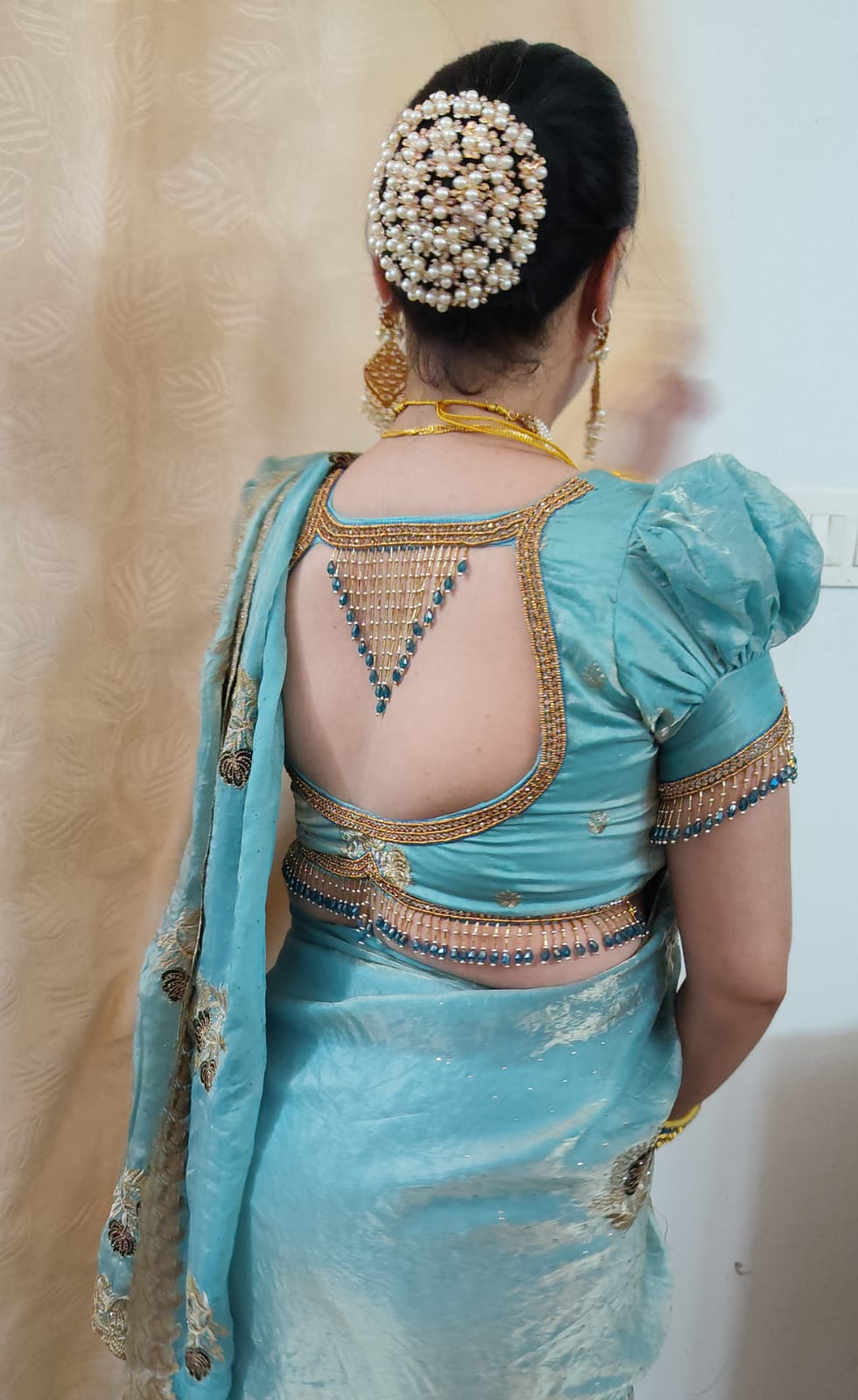
Look at the back
Where the work really goes
Front panels are seen for a moment. Backs are seen all evening: through a ceremony, across a dinner, in every photograph taken from behind. So that is where the beadwork earns its keep, and where a rushed piece gives itself away.
Every piece on this site has a close-up photograph of its work. Tap any image to enlarge it and look properly before you spend anything.
See the piecesWhat this means for you
Why we can't make it faster
When we say a piece takes up to two weeks, it isn't a queue, it's the frame time. The cloth has to be mounted, the design traced, the work built up in order, and the piece taken off and finished. Rushing any of it shows.
It is also why each design exists once. We'd rather put that time into something nobody else will be wearing.
Want this work on something of your own?
Send us a photograph of what you have in mind and the date you need it by. We'll tell you what the work involves and how long it will honestly take.
Ask us